
# Detailing Dilution Ratios: How to Measure a Spray Bottle Correctly
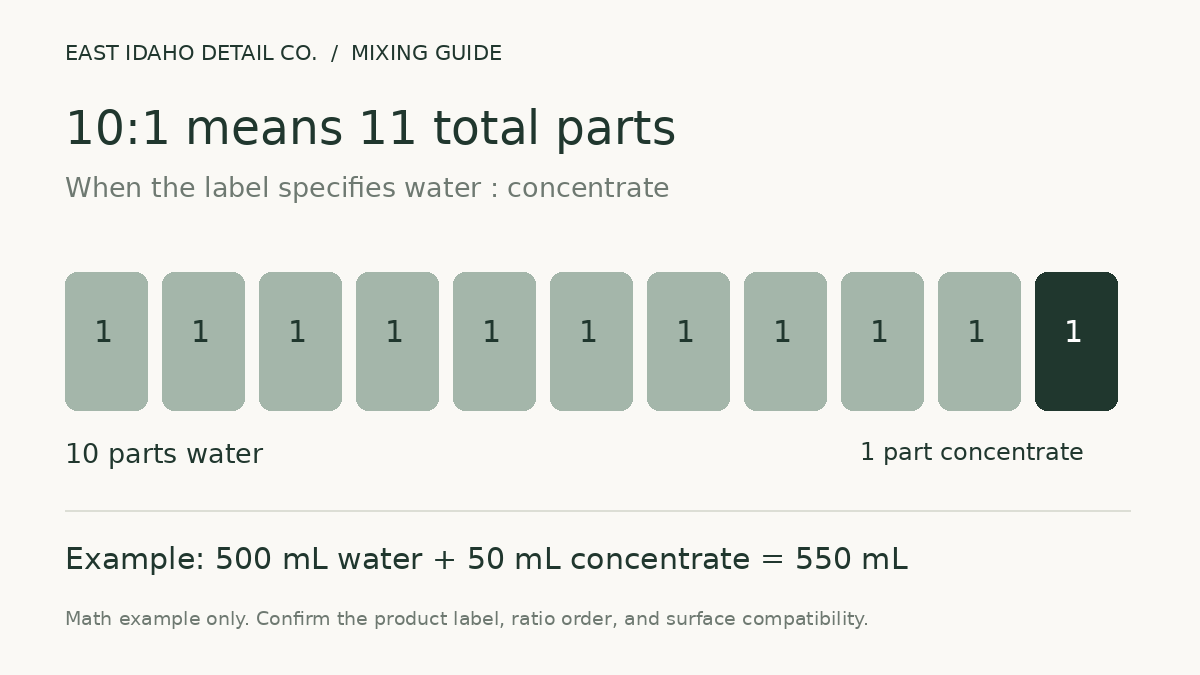
If a product specifies 10:1 water to concentrate, mix ten equal parts water with one equal part concentrate. That makes 11 total parts, not ten. For a planned 500 mL batch, the calculation is approximately 454.5 mL water and 45.5 mL concentrate.
But check the label before using that calculation. Some directions put concentrate first, some specify ounces per gallon of water, and some products are already ready to use. Correct math does not make an unsuitable product safe for a surface.
Read the whole instruction, not just the numbers
Before mixing, identify four things:
- The exact product and version. A similar name or bottle color does not establish that two formulas use the same directions.
- The intended task and surface. A wash-bucket instruction is not automatically an interior-spray instruction.
- The ratio order. Write “water : concentrate” or “concentrate : water” beside the numbers.
- What is being measured. Is the manufacturer specifying water to start with, or the total finished batch?
For example, one part concentrate to ten parts water can be written as 1:10 concentrate-to-water or 10:1 water-to-concentrate. Those describe the same mixture. If the order is unclear, ask the manufacturer rather than assuming.
A 10:1 water-to-concentrate mixture contains about 9.1% concentrate by volume under the usual additive-volume calculation. It is not the same instruction as “make a 10% solution,” and neither number tells you the percentage of active ingredient in the formula.
Calculate a batch for your spray bottle
Once the manufacturer confirms a water-to-concentrate ratio of N:1:
Concentrate amount = planned batch volume ÷ (N + 1)
Water amount = planned batch volume − concentrate amount
Use the same volume unit for both liquids. These examples use mL and a 500 mL working batch:
| Confirmed water : concentrate ratio | Concentrate | Water | Planned batch | | --- | ---: | ---: | ---: | | 4:1 | 100 mL | 400 mL | 500 mL | | 10:1 | 45.5 mL | 454.5 mL | 500 mL | | 20:1 | 23.8 mL | 476.2 mL | 500 mL |
Amounts are rounded to the nearest 0.1 mL to show the calculation, not to prescribe measurement precision for every product. This is a math chart, not a recommendation to use these strengths on any particular surface. Follow the product’s measuring instructions and use equipment precise enough for its required dose.
Choose a working volume below your bottle’s permitted fill level so there is room for the trigger assembly and any mixing space the instructions require. A bottle’s advertised capacity is not a reason to fill it to the brim.
An easier whole-number example
When a 10:1 water-to-concentrate mixture is approved, 500 mL water plus 50 mL concentrate gives a nominal 550 mL batch. That can be easier to measure than a 500 mL final batch—provided the container has enough working capacity.
Do not start with 500 mL water, add 50 mL product, and call it a 500 mL batch.
“Per gallon of water” is a different starting point
Optimum’s current No Rinse Wash & Shine Version 6 directions specify adding 1 US fluid ounce of product to 2 US gallons of water for the wash solution. That describes the starting water amount, not a finished two-gallon volume.
Using US units, two gallons of water is 256 fluid ounces. Adding one fluid ounce of product gives a nominal 257 fluid ounces of mixture. Halving that recipe means 0.5 fluid ounce of product added to one gallon of water.
That example demonstrates how to read the instruction; it is not a universal wash recipe. The same manufacturer page lists different dilutions for other uses. Check the directions for your bottle, version and task rather than carrying the wash dilution into every spray bottle.
Do not mix US and Imperial gallons or use weight ounces when the directions mean fluid ounces.
A simple mixing checklist
- Read the product label and safety data sheet. Follow the specified protective equipment, ventilation, water requirements and order of addition.
- Choose a compatible, dedicated container. Use one intended for that chemical; do not use a beverage bottle or a container with unknown residue.
- Measure the liquids. Use suitable marked equipment kept for chemical work, not food preparation. Do not estimate a dose by counting trigger pulls or capfuls unless the manufacturer defines that measure.
- Mix only as directed. Do not combine different cleaners or add a second chemical to “boost” the mixture.
- Label the working bottle. Include the exact product, full ratio order, intended task and mixing date, along with the manufacturer’s required secondary-container warnings. Keep the original label available.
- Follow application and storage directions. Check compatibility, spot-test where instructed, and observe dwell time and removal requirements. Do not assume diluted product has an unlimited storage life.
If you lose track of what is in a bottle, do not identify it by smell, color or a trial on the vehicle.
Concentrate or ready-to-use: which fits your kit?
A concentrate can make sense when you regularly use the product, can measure it accurately, and have suitable bottles and storage. Compare the cost of usable working solution at the approved dilution for your task, not just the price of the concentrate bottle.
Ready-to-use can be a better fit for occasional cleaning or a small kit where you want to avoid measuring and storing multiple mixtures. For example, Meguiar’s describes its G2406 All Surface Interior Cleaner as prediluted, with no mixing required. That does not make it interchangeable with every concentrated cleaner; surface compatibility still controls the choice.
These are manufacturer-instruction examples, not EIDC performance tests or confirmation that EIDC stocks either product.
EIDC’s interior-cleaning supplies page starts with your materials and cleaning needs. When planning a kit, also list your bottle sizes, measuring tools, cleaning frequency and existing supplies. A smaller ready-to-use option may be more useful than a larger concentrate you rarely need.
Request an EIDC custom-kit recommendation with those details. Product selection, current availability, pricing and fulfillment are confirmed before you approve an order.