
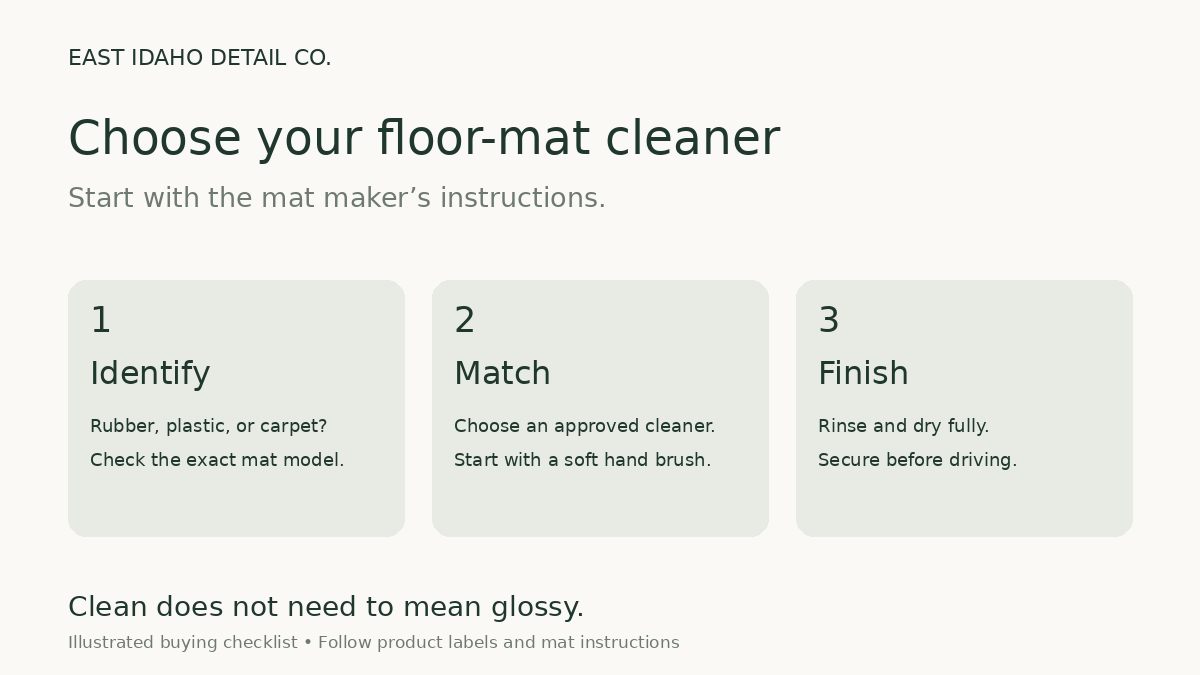
# How to Choose a Cleaner for All-Weather Floor Mats
Choose a floor-mat cleaner by matching both the cleaner label and your mat manufacturer’s care instructions. Start with the least aggressive approved cleaning method. Buy a protectant or powered brush only when the mat’s instructions support it—not simply because it comes in the box.
That approach makes a useful fall cleanup kit: enough to remove tracked-in dirt, without adding products you cannot use on your mats.
Identify the mat before choosing the bottle
“All-weather” describes a purpose, not one material. Look for the brand and model on the underside, then find its care guide. Separate molded rubber or plastic liners from carpet mats and mats with fabric inserts. Do not assume a cleaner approved for one works on the other.
For example, WeatherTech’s cleaning guide recommends its dedicated cleaner or mild detergent with warm water for the mats it names. Its FloorLiner care FAQ also warns against harsh chemicals and silicone-based protectants. Treat those as instructions for the specified WeatherTech products, not universal rules for every mat.
If you cannot identify the material, pause before buying a strong cleaner. A photo of the underside label is more useful than guessing from the mat’s color.
Compare the parts of a kit separately
| Item | What to check before buying | When to leave it out | | --- | --- | --- | | Cleaner | Both labels allow the mat material; directions explain application and removal | The mat maker excludes it, or compatibility is unclear | | Hand brush | Bristle type suits the texture and manufacturer’s instructions | Your existing approved brush already does the job | | Drill brush | Both tool and mat instructions support powered agitation | A hand brush is sufficient or compatibility is uncertain | | Protectant | The mat maker permits that specific treatment on the walking surface | It is intended only for tires, trim, or another surface | | Utility towel | Suitable for the cleaning task and kept separate from paint towels | You already have an appropriate dedicated towel |
A bundle is useful when all its components fit your job. An unused second bottle or an unsuitable brush adds little value, even if the box contains more pieces.
EIDC’s towels, brushes and tools page describes this same task-based approach: fill gaps around what you already own.
What current floor-mat kits illustrate
Meguiar’s lists a Quik Solutions All-Weather Floor Mat Kit in its 2026 range. Its announcement, dated June 9, 2026, describes a cleaner, matte protectant, drill brush and microfiber towel. The page also states a December 2025 retail rollout, so this is an existing product example—not an October launch.
Meguiar’s describes the treatment as non-greasy; that is a manufacturer claim, not an EIDC test result or confirmation that another mat maker approves it. Check your exact mat instructions before selecting either a complete kit or separate products.
This guide does not establish EIDC stock or pricing for either manufacturer. EIDC confirms product choices, availability and pricing when preparing a quote.
A controlled cleaning routine for removable molded mats
Use this sequence only where your mat’s instructions permit washing:
- Remove the mats. Follow the vehicle’s retention-system instructions and keep cleaning products out of the footwell.
- Remove loose debris first. Shake or vacuum dry grit, then rinse if the care guide permits it.
- Apply the approved cleaner as directed. Use the label’s dilution, dwell time and handling instructions. There is no single dilution ratio for every floor-mat cleaner.
- Agitate gently. Test a small area and start with an appropriate hand brush. Stop if the surface changes, scuffs or transfers color.
- Remove the cleaner completely. Rinse or wipe as the instructions require, then let the mat dry fully. Check grooves and the underside.
- Reinstall correctly. Engage the retention points, do not stack mats, and check that the driver’s mat cannot interfere with the pedals.
WeatherTech’s own routine similarly separates washing, drying and any approved conditioning. A protectant is a separate decision after cleaning; a glossy appearance is not a cleaning requirement.
For carpet mats, use the carpet-specific instructions instead of this rinse-based routine.
If the mat still looks dirty
Before escalating to a stronger chemical, let the mat dry and inspect it in good light. Identify what remains: loose soil in channels, cleaner residue, a stain, or visible surface wear. Those are different problems, and another cleaner will not repair worn texture.
Avoid repeatedly increasing concentration to chase a cosmetic result. Record what you used and ask the mat manufacturer about the remaining mark. If you plan to clean outside in cold weather, allow a suitable place and enough time for complete drying before you need the vehicle.
Build the smallest useful mat-care kit
For a recommendation, provide the mat brand and model, photos of the material and problem, the products and brushes you already own, and whether you have a suitable rinsing and drying space.
Request an EIDC custom-kit recommendation with those details. EIDC can discuss suitable supplies, current availability and pricing before you approve an order.